
Spaced Repetition Schedule: How to Use Spaced Repetition to Learn a Language
Andrei Kuzmin / Last updated: September 25, 2026
A spaced repetition schedule reviews each word at growing intervals: soon after you learn it, then after a day, a few days, a few weeks and a few months. Every correct answer pushes the next review further out, and every mistake brings the word back sooner. A spaced repetition app calculates these gaps for you, card by card.
In my opinion, spaced repetition is the most effective way to memorize vocabulary in a new language. It's a memorization technique in which you review material according to an algorithm, at fixed or changing intervals. The idea works for any information, but it's used most widely for learning foreign languages. And it doesn't replace understanding or memory tricks: it simply makes sure you see each word again at the right moment.
This guide is about the practical side: which intervals to use, how the best-known systems schedule reviews, and how to build a daily routine that actually sticks.
What is spaced repetition?
Spaced repetition means reviewing information at increasing intervals instead of all at once. It's usually done with flashcards: new and difficult cards come back often, while older and easier cards come back less and less, to take advantage of the spacing effect. The German psychologist Hermann Ebbinghaus first described this effect in 1885, and spaced repetition is now one of the best-studied learning methods.
It fits language learning especially well, because you need to learn thousands of words and keep them for years. If you want the full picture of how a spaced repetition system works, read our guide: what is a spaced repetition learning system.
Why do growing intervals work so well?
Each time you wait a little longer before a review, the word becomes a bit harder to recall. That extra effort is exactly what helps: pulling a half-forgotten word out of memory makes the memory stronger and moves it deeper into long-term memory.
The right gap also depends on how long you want to remember something. In a large 2008 study, Nicholas Cepeda and his colleagues taught more than 1,350 people a set of facts and tested them up to a year later. The best gap between study sessions was about 20-40% of the time until the test when the test was a week away, but only about 5-10% of that time when it was a year away. For vocabulary you want to keep for years, this means the gaps should keep growing: from days to weeks to months.
What spaced repetition intervals should you use?
Best for: anyone who wants to understand the numbers behind a spaced repetition schedule.
There's no single perfect schedule, but two classic systems show what good intervals look like.
In 1967, the linguist Paul Pimsleur published a schedule called graduated interval recall, designed for audio language courses. His intervals were: 5 seconds, 25 seconds, 2 minutes, 10 minutes, 1 hour, 5 hours, 1 day, 5 days, 25 days, 4 months and 2 years. Each gap is roughly five times longer than the one before.
In 1987, Piotr Woźniak created the SM-2 algorithm for his SuperMemo program. SM-2 shows a new card again after 1 day, then after 6 days, and then multiplies each interval by an "easiness factor" that starts at 2.5 and changes with your answers. If the easiness factor stays at 2.5, that means reviews after 1, 6, 15 and 38 days. Modified versions of SM-2 still power popular apps such as Anki.
Both systems share one principle: the better you know a word, the longer it waits. That's also why you shouldn't plan reviews by hand for thousands of words. Let an app do the math.
How does the Leitner box schedule cards?
The Leitner box is the paper version of spaced repetition. Flashcards are sorted into groups by how well you know them. When you recall a card correctly, it moves to the next group; when you miss it, it goes back to the first group. Each following group is reviewed less often, so hard words keep coming back while easy ones step aside.
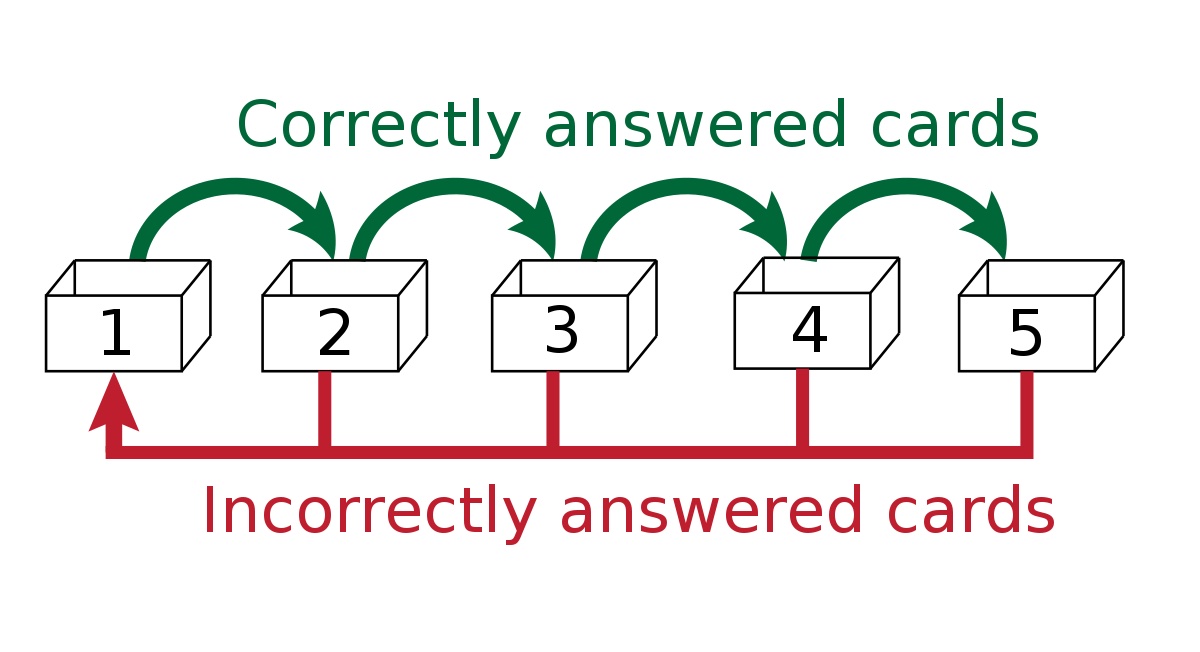
In the original method, the schedule depended on the size of each box: you reviewed a group only when it filled up, moving cards forward or back depending on your answers. It works well with paper, but it gets hard to manage once you have more than a few hundred cards. I explain the method step by step in our guide to language flashcards.
How does Lingocard schedule your reviews?
Lingocard's spaced repetition system replaces all of this with three buttons. After you try to recall a card, you tap Hard, Good or Studied:
- Hard brings the card back soon.
- Good sends it further away.
- Studied takes it out of the deck until you choose to review studied cards again.
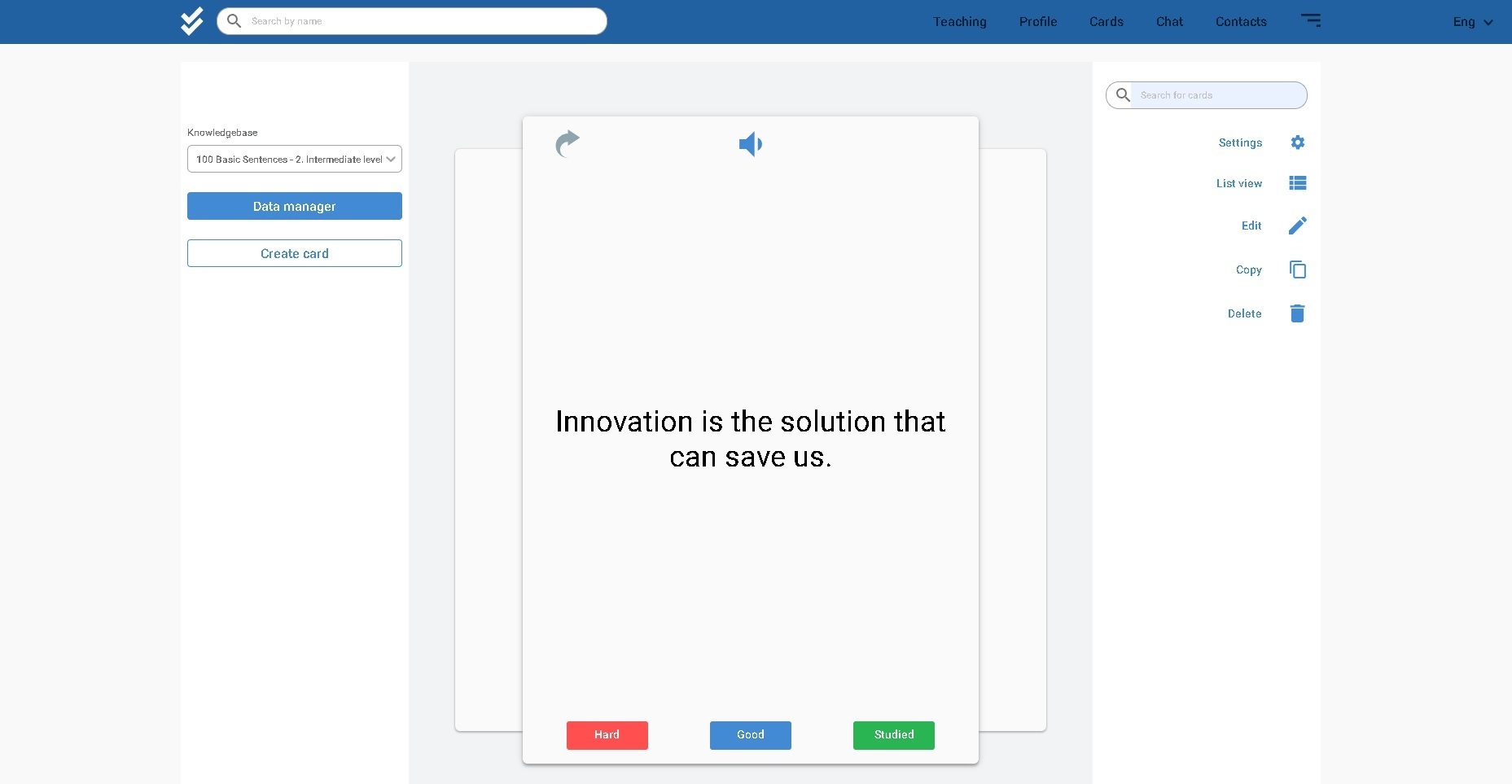
Unlike most apps, Lingocard measures the gap in cards rather than calendar days. So if you skip a few days, there's no pile of overdue cards waiting for you: your place is simply kept, and the right cards come back in the right order when you return.
You can adjust the system to your own pace: set how many exercises you want per day, get study reminders at the times you choose, hear every card read aloud and, with Premium, turn your own word lists into decks. Your progress syncs with the cloud, so you can switch between devices. In the Lingocard mobile app, everything you study is also stored on your phone, so you can keep reviewing without an internet connection, even on a plane.
How to build a daily spaced repetition routine
Best for: turning spaced repetition into a habit that lasts.
- Review first, then learn. Start each session with the cards that are due. New words can wait; the ones you're about to forget can't.
- Add new words in small batches. A few new words every day beat a hundred once a week. Start with the most common words, for example The 100 Most Common Spanish Words with Pronunciation, and read why in our guide to the frequency dictionary.
- Rate yourself honestly. If you hesitated, tap Hard. Honest ratings are what make the schedule work for you.
- Learn words inside phrases. A word in a short sentence is easier to recall and easier to use in conversation.
- Use the gaps in your day. Review on your phone during a commute, or on a computer in the web app, and your schedule stays the same everywhere.
- Study at the same time every day. Set a reminder, and let the routine carry you on days when motivation is low.
What are the most common spaced repetition mistakes?
- Cramming new words. Adding too many cards at once creates a wave of reviews a few days later, and that's when many people give up.
- Rating too kindly. Tapping Good when you actually struggled pushes a word too far away, and you'll forget it before it returns.
- Quitting after a break. Missing a few days is normal. With card-based scheduling, you simply continue where you left off.
- Learning isolated words only. Mix single words with phrases and whole sentences, so you can use them when you speak.
Spaced repetition is the engine, but you still choose what to feed it. Pick words that matter to you, review a little every day, and let the schedule do the rest. You can start right away with our free flashcards app.
If you teach, the same schedule works for a whole class: you can teach languages with Lingocard and send your students decks that come back for review right before they would forget them. And whether you learn or teach, the Lingocard language learning platform is free to start in every country.
Frequently asked questions
Review a new word soon after you learn it, then after about a day, a few days, weeks and months, pushing each review further out when you remember and bringing it back sooner when you forget. The SM-2 algorithm, for example, uses 1 day, then 6 days, then multiplies each interval by about 2.5.
In 1967, Paul Pimsleur proposed 5 seconds, 25 seconds, 2 minutes, 10 minutes, 1 hour, 5 hours, 1 day, 5 days, 25 days, 4 months and 2 years, each gap roughly five times longer than the one before.
Put words and short phrases on flashcards, review the cards that are due before adding new ones, rate each recall honestly and add a few new words every day. An app like Lingocard schedules every card for you.
In most apps, overdue cards pile up. Lingocard measures gaps in cards rather than calendar days, so after a break your place is kept and the right cards come back in the right order.
It depends on how long you need to remember. A 2008 study by Cepeda and colleagues found the best gap was about 20-40% of the retention time for a test one week away, but only 5-10% for a test one year away.