
Last updated: June 11, 2026
Spaced Repetition Learning System for Language Learning
Lingocard schedules every flashcard for review at the moment you are about to forget it, so vocabulary moves into long-term memory with the least possible effort - free, adaptive, and built for 67 languages on web, iOS, and Android.


Hello. How are you?
The system
What is a spaced repetition learning system?
A spaced repetition learning system is a study method that shows you each piece of information at growing intervals, timed to the way memory naturally fades. Instead of reviewing everything every day, the system tracks how well you know each item and schedules its next review for just before you would forget it. The better you know a word, the less often it appears; difficult items come back more frequently until they are firmly fixed in memory, and once you have truly mastered an item it leaves the active cycle altogether.
Three things separate a true spaced repetition system from an ordinary study app: the interval between reviews changes based on your performance, each item is scheduled individually, and you give a feedback signal on every review that sets the next interval. The technique works for almost any subject, which is why medical students and exam candidates rely on it, but Lingocard builds it out fully for language learning, with native audio, frequency dictionaries, and 67 languages ready to study.
The science
How spaced repetition works: the forgetting curve
In 1885 the psychologist Hermann Ebbinghaus described the forgetting curve, the steep way memory of new information drops off in the hours and days after you learn it. The curve is the reason a vocabulary list you studied last week feels gone today. It is not a lack of talent; it is simply how memory behaves when information is not revisited.
The forgetting curve, flattened by spaced repetition
Each successful recall strengthens the memory and the curve falls more slowly, so the next review can wait longer - the spacing effect at work.
Spaced repetition flattens that curve. The research behind it is robust: a 2022 review in the journal PMC found that spacing study sessions over time produces stronger memory than cramming the same material at once, and a 2023 cohort study in Cureus found that students using spaced repetition scored several percentage points higher on standardized exams than those who did not. For language learners, who must commit thousands of words to memory, that efficiency is the difference between giving up and reaching fluency.
Two forces do the heavy lifting on every review. Active recall, the effort of retrieving an answer before you reveal it, signals to your brain that the item matters. Spaced scheduling then places the next retrieval at the ideal time. Together they build durable memory far faster than re-reading ever could.
The method
How our spaced repetition system works
Lingocard's system is simple to use and genuinely adaptive underneath. Here is what happens on each card.
Recall
A card appears with a word or phrase. You try to remember its meaning and pronunciation before revealing the answer.
Rate it
You tell the app how it went with one tap: Hard, Good, or Studied. That single rating is the feedback signal that drives everything.
Reschedule
The algorithm sets when that exact card returns. Hard cards come back soon, Good cards wait longer, and Studied cards step aside so you focus on what you are still learning.
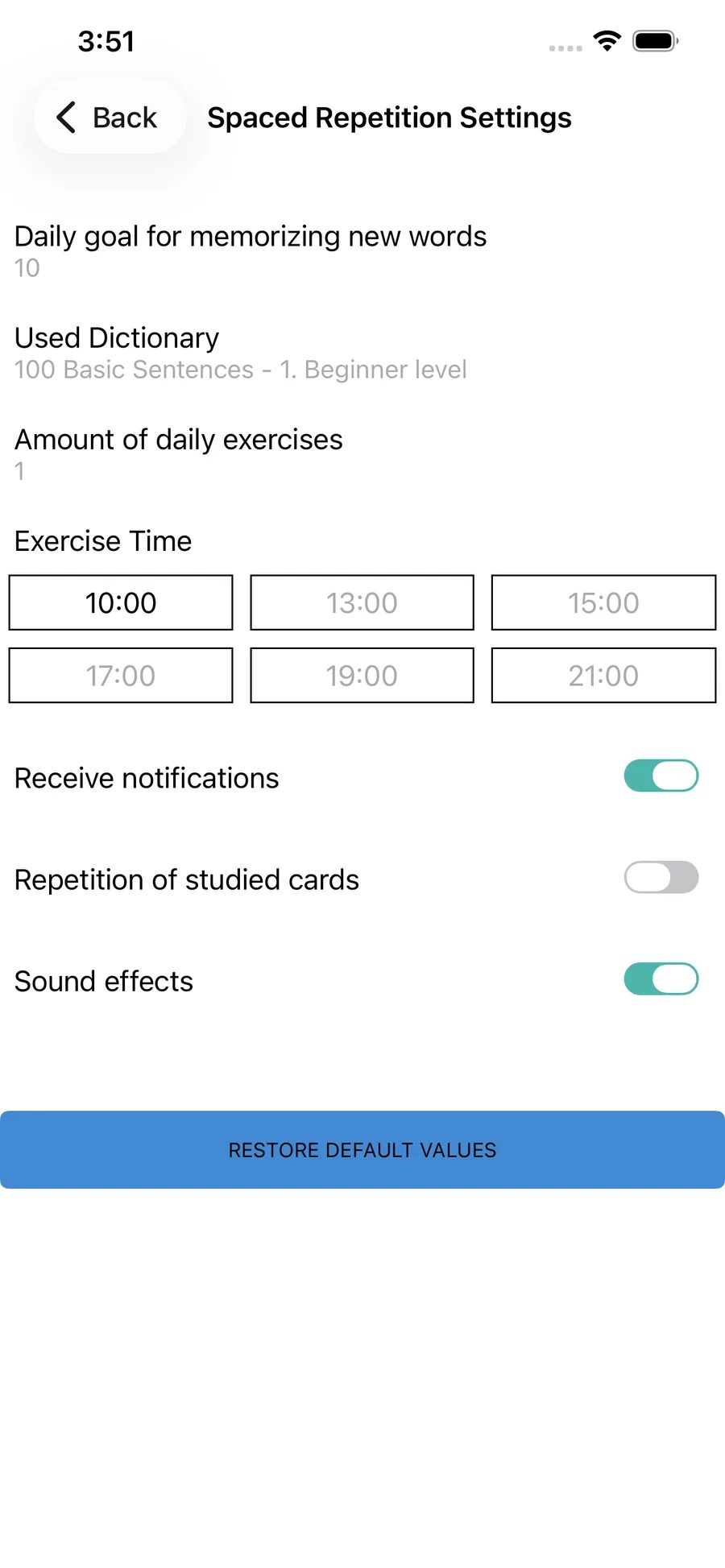
Because every card is scheduled on its own, your review queue is always the shortest path to remembering more. You can open the spaced repetition settings to tune the system to your memory, mix new and due cards your way, change which side of the card opens first, and decide whether studied cards reappear. There are dozens of settings, so the system fits your habits rather than forcing you into someone else's.
It gets better the longer you use it
The algorithm and AI need a little time to learn your pace and your strengths, so the more you practice, the more precisely your reviews are timed. Spaced repetition rewards consistency, and Lingocard is built to make it easy.
The differentiator
Scheduling that fits your life, not a fixed calendar
Most spaced repetition apps schedule by the calendar: review this card in one day, that one in one week. The problem is obvious the first time life gets in the way. If a card was due in one week and you could not study for two, the timing is already broken, and a long absence can leave you facing a wall of overdue cards.
Tied to dates that break
Miss a couple of days and every due card piles up at once.
Ordered by how well you know it
Skip days and your place is kept. The right cards wait in the right order.
Lingocard schedules by your actual practice instead. The system orders cards by how well you know them and serves the next ones in the right sequence whenever you study, rather than tying each card to a fixed date. The result is a system that bends to your routine, which is exactly what keeps people learning over months instead of quitting in week two.
Multi-sensory memory
Spaced repetition with native audio and image associations
Strong memories have more than one anchor, so Lingocard reinforces every review with sound and sight. Each card can be heard in high-quality native pronunciation, in both your native and target language, so you train your ear and your recall on the same review. Because we generate dedicated audio files for pronunciation, playback is fast and consistent every time a card comes due.
You can also attach an image or visual association to any card. A word tied to a picture is far easier to retrieve, and in a spaced repetition system - where you meet each item many times over weeks - that visual hook pays off on every repetition.
Build and manage decks in the Flashcards App
the beach
No fakes
Real spaced repetition, not just reminders
Many apps claim spaced repetition but only send a daily notification that says it is time to study. That is a reminder, not a spaced repetition system. An app that shows the same material on a fixed schedule wastes time on words you already know and lets the hard ones slip away.
A reminder app
It's time to study
- Shows the same material on a fixed schedule
- Wastes time on words you already know
- Lets the hard ones slip away
Lingocard: the real thing
Reviewing at the edge of forgetting
- Intervals adapt to your performance
- Each item is tracked separately
- Your rating on every card decides what comes next
If you have used a polished app that promised retention and did not deliver, this adaptive scheduling is usually the piece that was missing.
Stay consistent
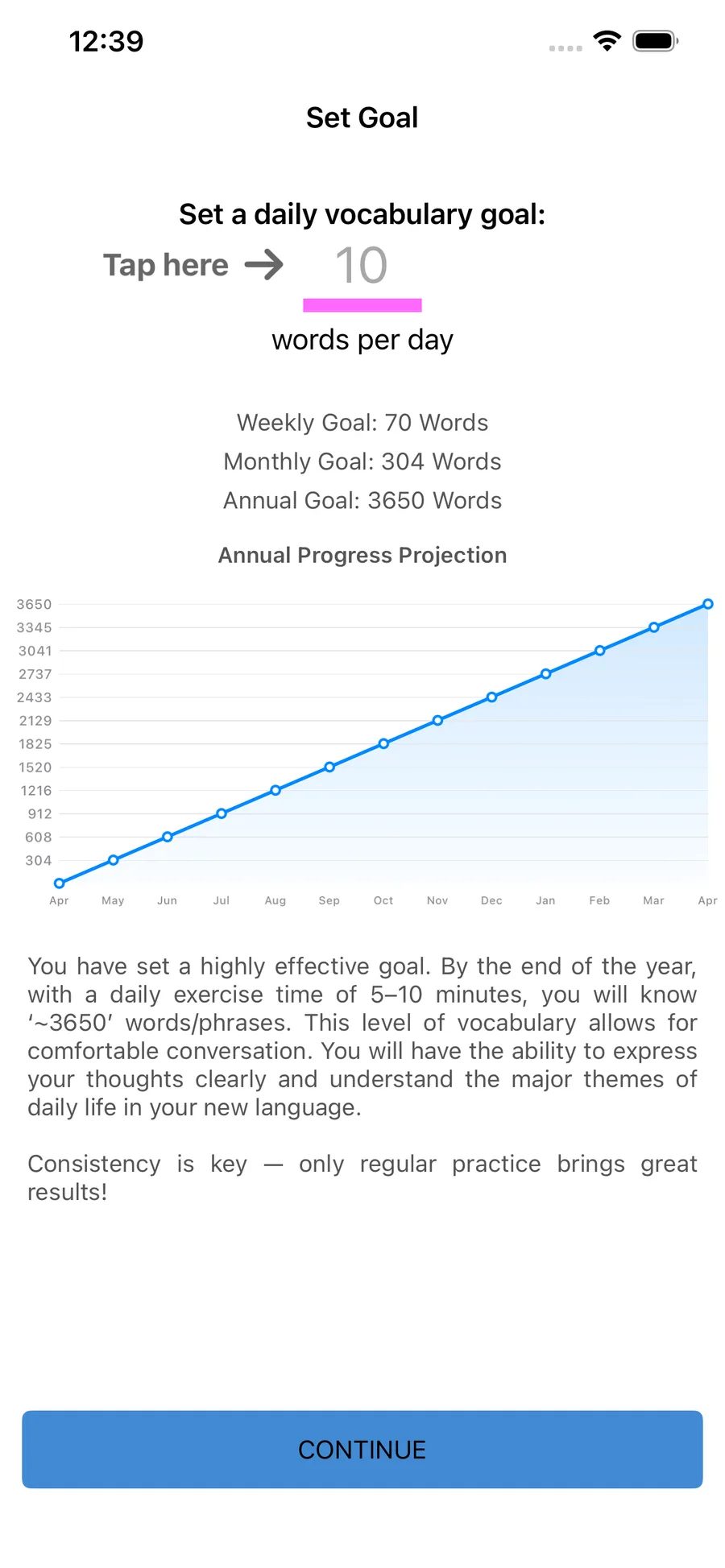
Set goals from daily to yearly and track your progress
A spaced repetition system only works if you keep showing up, so Lingocard is built to keep you consistent. Set a goal for your reviews by day, week, month, or year, and a goal indicator on each card shows how close you are to reaching it. When you hit a target, the app marks the win, which turns review into a habit you can feel. Adjustable reminders prompt you to study at the times that suit you, so sessions land in the gaps you actually have.
Your progress page charts how many cards you have studied each day, week, and month, with built-in graphs and calculations, so you can watch your vocabulary grow and your streak build. Studied cards are kept separately as well, ready to revisit whenever you want to confirm something has truly stuck.
Try it
See how the schedule reacts to your answers
Rate each card the way you would in a real session and watch how the next review changes. This is the core of spaced repetition in miniature.
For educators
For teachers: send lessons as spaced-repetition flashcards
Lingocard is built for teachers as well as independent learners. A teacher can turn a lesson into a deck of flashcards and send it to students, who then lock it into memory with the same spaced repetition system - complete with audio and progress tracking - on their own devices.
Teacher builds a deck
Turn any lesson's vocabulary into a flashcard deck with audio and images.
Students review on their devices
Each student memorizes it with spaced repetition and tracked progress.
Instead of vocabulary that is forgotten by the next class, students review each word on the schedule that actually produces retention, which frees classroom time for real conversation. This makes homework measurable: you assign the words, the system spaces the reviews, and progress is tracked automatically. If you plan to teach at scale, see Create your online school, where the lessons you send become spaced-repetition study for every student.
Anywhere, anytime
Study anywhere: offline, hands-free, on every device
Reviews work best when they happen often, so Lingocard removes every excuse to skip one. The system works fully offline - study on a plane or anywhere without a connection; your sessions are saved locally and synced the next time you are online, keeping your schedule and streak intact.
There is also a flashcard audio player you can launch right from the spaced repetition page. It pronounces your cards one after another, in the order the algorithm chooses for best memorization, so you can learn hands-free while driving, running, or standing in line. Imagine playing a deck like music and absorbing vocabulary in moments that would otherwise be lost.
Learn more on our mobile app and web app for language learning.
The honest comparison
Lingocard vs. Anki vs. Quizlet for spaced repetition
If you are comparing spaced repetition tools, here is an honest look at how Lingocard stands next to two of the best-known names. Anki is powerful and free on most platforms but has a steep learning curve, and Quizlet is easy to use but offers limited true spaced repetition on its free plan.
| Feature | Lingocard | Anki | Quizlet |
|---|---|---|---|
| True adaptive spaced repetition | Yes, free | Yes | Limited on free plan |
| Practice-based scheduling (not fixed calendar) | Yes | Interval-based | Fixed |
| Built for language learning | Yes, 67 languages | General-purpose | General-purpose |
| Native audio pronunciation | Built in, free | Add-on / manual | Limited |
| Image associations on cards | Yes | Yes | Limited |
| Goals: daily to yearly + progress charts | Yes | Basic | Basic |
| Teacher decks sent to students | Yes | Manual sharing | Paid tiers |
| Audio player (study hands-free) | Yes | Add-on | No |
| Offline study | Yes | Yes | Paid |
| Ease of use | Beginner-friendly | Steep learning curve | Easy |
| Price of core features | Free | Free desktop, paid iOS | Subscription for key features |
Swipe to compare
Lingocard was created by language learners and teachers for their own use first, so it pairs a serious spaced repetition engine with a clean, modern design, and connects it to a full platform: flashcards, frequency dictionaries, a global social network, and educator tools. You get the retention power advanced tools are famous for, without the setup, the tutorials, or the paywall.
67 languages
Spaced repetition for 67 languages
Lingocard's spaced repetition system supports 67 languages, from the most widely spoken to regional ones. Whatever you are learning, the scheduling, the audio, and the goals work the same way, and polyglots can run several languages at once and switch between them in a tap. When a word comes up in our speaking practice network, you can save it straight to a spaced-repetition card.
Loved by learners
Vocabulary that finally sticks
I skipped almost two weeks during exams and came back terrified of a huge backlog. There was no wall - the right cards were just waiting in order. That alone kept me going.
Switching from a fixed-schedule app was night and day. Lingocard actually feels like it knows which words I'm shaky on, and the audio plays instantly every time.
I assign each lesson's words as a deck and my students actually remember them by the next class. Homework finally produces retention instead of cramming.
The audio player is my secret weapon. I run my due cards like a playlist on my commute and the words are already familiar when I sit down to review.
I bounced off Anki twice - too fiddly to set up. This just works: I rate a card and trust it to bring the word back at the right moment. Three months in and my French finally sticks.
I keep one deck for medical vocab and another for everyday Korean, and the player lets me drill both on the subway. Hearing each card out loud is what really sold me.
What surprised me was the progress page. Watching the weekly graph creep up keeps me opening the app even on the days I do not feel like it. Small thing, big difference.
I started adding a photo to my trickiest words and they stopped slipping away. The picture and the audio together stick far better than a plain list ever did for me.
The algorithm clearly learns me. The words I keep fumbling come back fast, and the ones I know disappear for weeks. After a month it feels tuned to exactly what I am weak on, not a one-size-fits-all schedule.
What I love most is that it is not chained to a calendar. I travelled for ten days, opened the app, and there was no guilt pile of overdue cards - it just picked up exactly where my memory actually was.
Launching the audio player straight from my review session is genius. I play the due deck while cooking and half the session is already done before I even sit down to study.
Most of my studying happens on the metro with no signal. It works completely offline and syncs the second I am back online, so my streak has never broken because of a dead zone.
Frequently asked questions
What is a spaced repetition learning system?
Does spaced repetition really work?
Is Lingocard's spaced repetition system free?
How is this different from apps that just remind me to study?
What happens if I skip several days?
Does the system get better the more I use it?
Can I hear how words are pronounced during review?
Can I add images to my cards?
Can I set goals for spaced repetition?
Can teachers use Lingocard's spaced repetition with students?
Is Lingocard a good free alternative to Anki?
Which devices does the Lingocard Spaced Repetition System work on?
Start learning with spaced repetition today
Stop forgetting what you worked to learn. Create a free account, pick your language, and let Lingocard's spaced repetition system schedule every review at the perfect moment, so your vocabulary finally sticks.
For further reading
Learn more on the blog
Go deeper on spaced repetition, the forgetting curve, and vocabulary that lasts.
Best Spaced Repetition Learning System